
A Day Without Notifications: What Changes When Your Phone Stops Interrupting You
What happens when notifications stop for a day? A reflective look at focus, attention, boredom, and emotional calm without constant alerts.
This is a reflective look at why the internet feels louder than ever while real change seems limited, exploring repetition, attention, and the gap between online noise and progress.

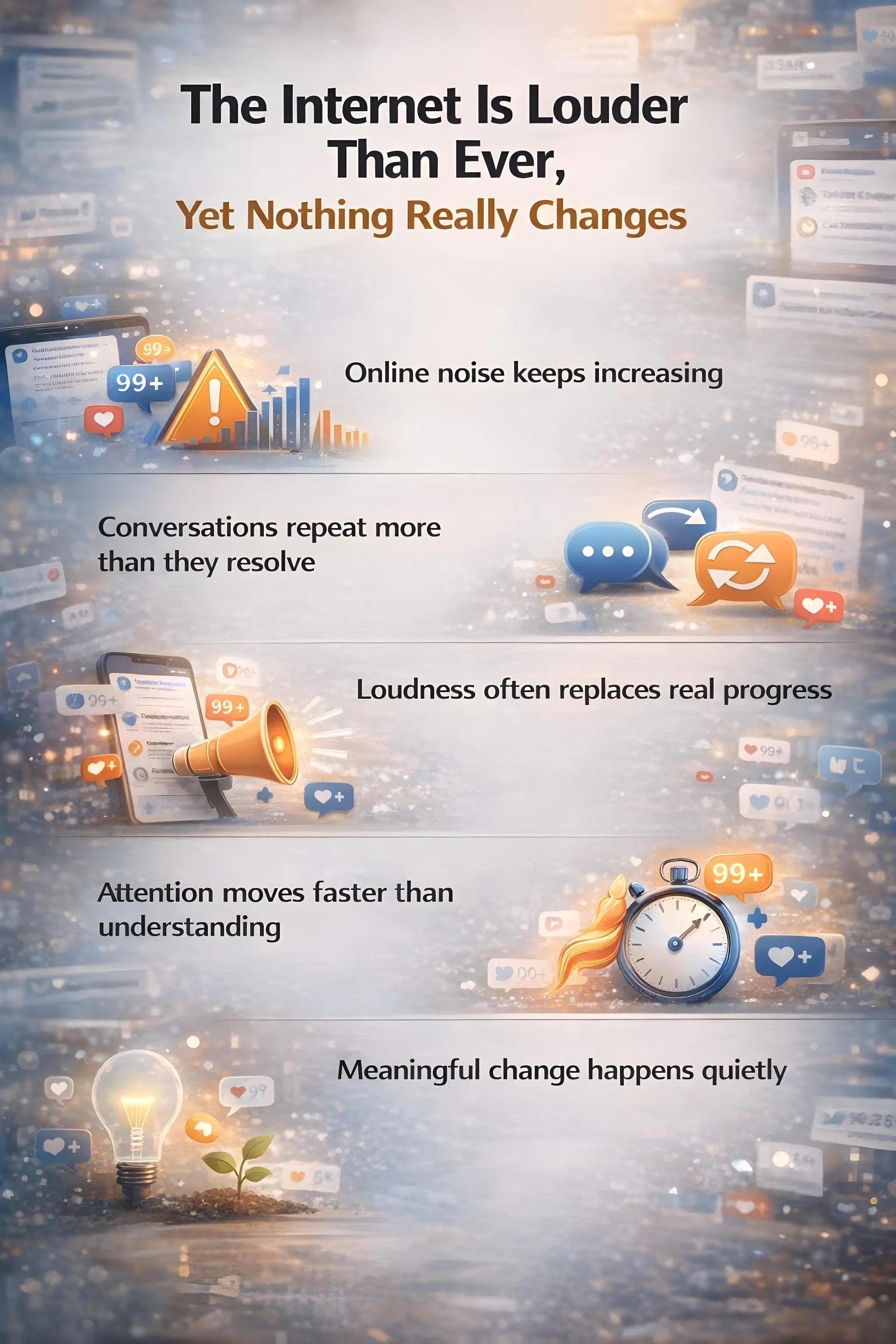
The internet has never been quieter, and yet it has never said so much. Every day begins with notifications, updates, headlines, opinions, reactions, and responses layered on top of each other. Screens refresh constantly, feeds move endlessly, and conversations never seem to pause. From the outside, it feels like everything is happening all at once. And yet, when you step back, it becomes harder to point at what has actually changed.
This contrast between noise and movement is one of the defining features of modern internet culture. The volume keeps increasing, but the direction feels unclear.
The internet is built to amplify voices. Social platforms reward frequency, urgency, and emotional expression. The louder something sounds, the more visible it becomes. Over time, this has created an environment where silence feels like absence and restraint feels like irrelevance.
Every topic is discussed repeatedly, often in slightly different words, by thousands of people at the same time. Opinions stack on top of opinions, forming a kind of digital echo. The speed of this exchange makes it feel important, but speed alone does not guarantee meaning.
What’s striking is how quickly yesterday’s loud conversation disappears. The internet rarely slows down long enough to sit with an idea. It moves on, even if nothing was resolved.
There is constant motion online. Trends rise and fall. Platforms change features. Creators shift formats. Algorithms adjust quietly in the background. On the surface, this looks like progress.
But much of this movement circles the same ideas. Discussions repeat with a new language. Problems are reintroduced as discoveries. Solutions are promised again, slightly repackaged. The sense of forward motion often comes from repetition rather than resolution.
This creates a strange feeling where everything feels urgent, yet nothing feels settled. The internet moves fast, but it doesn’t always move forward.
Loudness is easy to mistake for change. When something is discussed everywhere, it feels significant. When it trends, it feels new. But visibility does not always reflect impact.
Many online conversations exist primarily to be seen. Engagement becomes the goal rather than understanding. The act of participating replaces the need for an outcome. In this environment, change is implied rather than measured.
Over time, this shapes how people interpret activity. If something is being talked about constantly, it must be important. If it fades, it must have been resolved. Often, neither is true.
The internet compresses attention into small moments. Content is designed to be consumed quickly, reacted to immediately, and replaced just as fast. This compression leaves little space for reflection.
When attention is constantly redirected, ideas don’t mature. They appear, peak, and vanish before deeper understanding forms. This cycle creates familiarity without depth. People recognize topics but rarely engage with them long enough to change behavior or perspective.
As a result, many discussions feel endless yet incomplete, as if they restart every few weeks without remembering what came before.
One reason it feels like nothing changes is that the internet frequently reintroduces old ideas as new ones. The context shifts, the wording updates, and the platforms evolve, but the core conversations remain similar.
This repetition creates the illusion of renewal. Each cycle feels fresh because the audience is new or the framing is different. But for those paying attention, the pattern becomes visible.
The internet thrives on rediscovery more than resolution. It is better at resurfacing ideas than concluding them.
Living in a loud digital environment has subtle effects. Constant exposure to opinions and urgency can create fatigue without clarity. People feel informed but uncertain, connected but restless.
When everything demands attention, it becomes difficult to know what truly matters. The result is often disengagement rather than action. Silence becomes a form of self-protection rather than reflection.
This emotional undercurrent is rarely discussed because it doesn’t trend well. Quiet experiences don’t compete easily with loud content.
Real change often happens slowly and quietly, away from trending topics. It happens in habits, decisions, and long-term shifts that don’t fit neatly into a post or headline.
The internet is good at announcing change, but less effective at sustaining it. It documents moments better than it supports transitions. This creates a gap between what is visible online and what actually evolves.
Because of this, the most meaningful changes are often invisible to the loudest spaces.
When the volume is lowered, what remains is not emptiness, but space. Space to notice patterns, to question assumptions, and to step out of the cycle of constant reaction. The idea that nothing really changes is not a statement of hopelessness. It is an observation about pace and perception. Change does happen, but it rarely matches the intensity of online conversation.
The internet will likely continue to get louder. Platforms will evolve, formats will shift, and discussions will repeat. The challenge is not keeping up with the noise, but recognizing when it is simply noise.
Sometimes, the most accurate observation is not about what is happening, but about what isn’t. And in a world that never stops talking, noticing that nothing has truly changed can be its own form of clarity.
The internet feels louder than ever because it is designed to be. Every platform rewards speed, reaction, and visibility, creating a constant sense of movement. But movement alone does not guarantee progress. Much of what feels new online is often repetition in a different form, resurfacing familiar ideas without fully resolving them.
This does not mean change is impossible or absent. It means that real change rarely matches the volume of online conversation. It happens slowly, quietly, and often outside the spaces where attention is most concentrated. The internet documents moments well, but it struggles to sustain reflection or support long-term shifts.
Recognizing this gap between noise and change offers a different way of engaging. Instead of reacting to every surge of attention, there is value in pausing, observing patterns, and stepping back from constant urgency. In a culture built on endless updates, noticing what stays the same can be more revealing than following what trends.
Sometimes, clarity does not come from adding another voice to the noise, but from understanding when the noise itself has become the message.

A digital professional with over 12 years of corporate experience and a postgraduate qualification in Business Analytics and Business Intelligence. He has hands-on expertise in data visualization, SEO, digital marketing, web design, and modern web development with Next.js, along with practical experience as an AI generalist working on generative AI–driven business use cases. His work focuses on understanding digital transformation in the age of artificial intelligence and translating data, technology, and design into clear, user-centric digital experiences.
What happens when notifications stop for a day? A reflective look at focus, attention, boredom, and emotional calm without constant alerts.
This is a reflective look at why constantly following tech updates becomes exhausting, exploring information overload, mental fatigue, and the hidden cost of staying “up to date.”