This is a thought experiment exploring what would happen if artificial intelligence stopped improving tomorrow, examining expectations, creativity, work, and our relationship with technology.
Artificial intelligence is almost always discussed as something that is constantly accelerating. Each update feels bigger than the last, and new tools appear faster than most people can fully understand or adapt to them. Progress is assumed, rarely questioned. The idea that AI will keep getting better has become a background belief rather than a topic of reflection.
But it is worth pausing for a moment and considering a simple question. What if artificial intelligence stopped improving tomorrow? Not slowed down. Not redirected. Just frozen at exactly the level it exists today.
Freezing AI at Its Current State
If AI development paused tomorrow, the tools we use today would still exist. Writing assistants would continue generating text. Image generators would still create visuals. Translation tools, recommendation systems, and automation software would work exactly as they do now. Nothing would suddenly break. At the same time, nothing would get better.
For many users, this might not feel dramatic at first. In fact, some might feel a sense of relief. The constant flow of updates, announcements, and new tools has already become overwhelming. A pause could feel like a chance to breathe, a moment where learning finally catches up with innovation.
How Workflows Would Begin to Settle
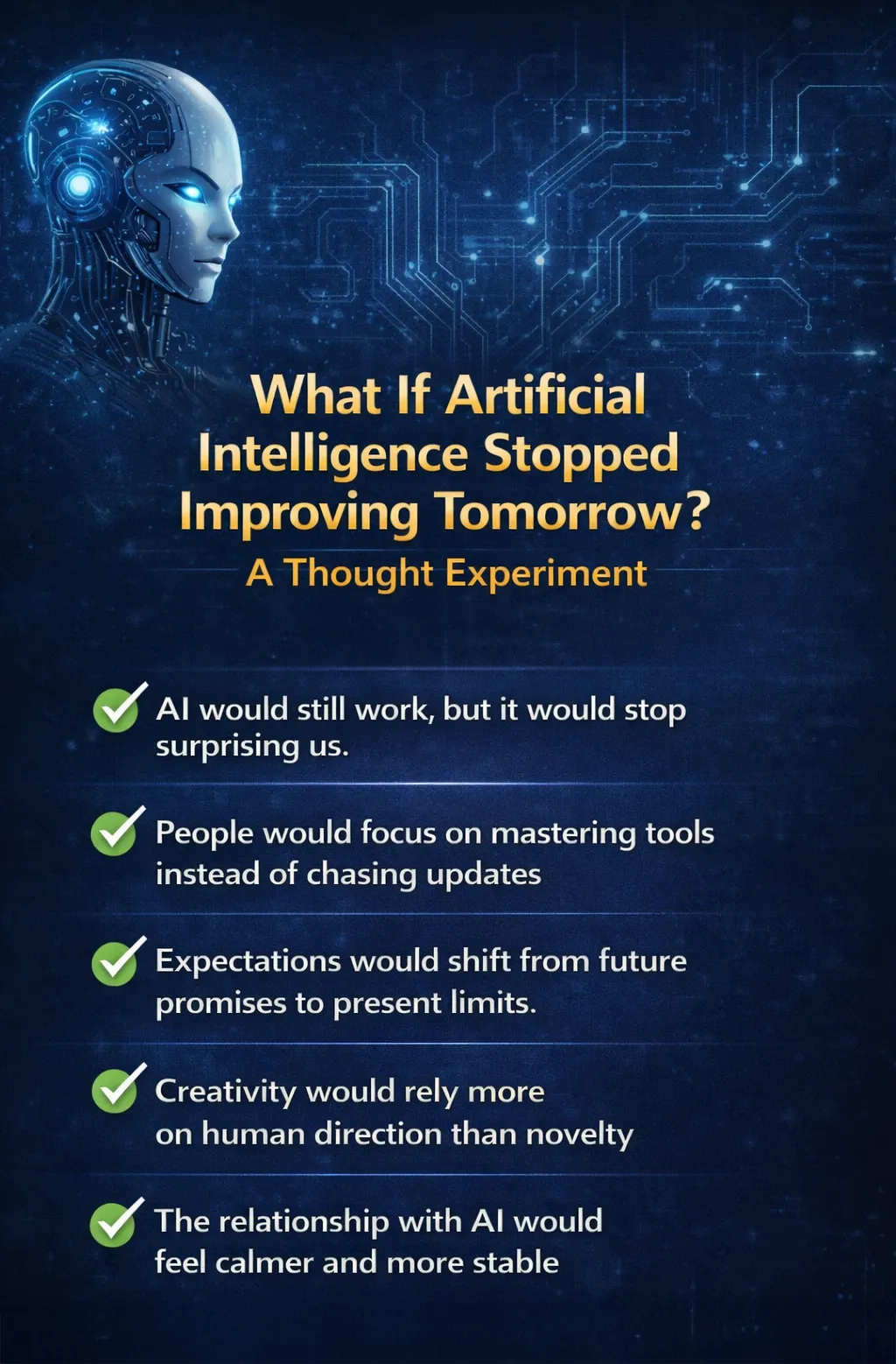
Without constant improvements, people would likely stop chasing the “next best tool” and start focusing on the tools they already use. Workflows would stabilize. Teams would build long-term processes instead of adjusting every few months to new features or changing interfaces.
Over time, AI would feel more predictable. Instead of endless experimentation, users would develop deeper familiarity. Strengths and limitations would become clearer. The relationship would shift from exploration to understanding, from novelty to reliability.
The Shift in Expectations
Right now, many expectations around AI are tied to the future. People accept imperfect results because they believe improvement is always just around the corner. Bugs, inaccuracies, and limitations are often tolerated with the assumption that the next update will fix them.
If progress stopped, expectations would change. Users would become more critical, but also more realistic. AI would no longer be treated as an evolving promise, but as a fixed tool. Similar to traditional software, it would be judged by what it does today, not what it might do tomorrow.
The Impact on Creativity
AI tools are often described as creative partners. If they stopped evolving, creators would quickly notice repeated patterns and familiar outputs. The novelty of AI-generated content would fade faster, and human input would become more important again.
Writers, designers, and musicians would shift their focus. Instead of waiting to see what the tool can do next, they would learn how to guide it more intentionally. Creativity would come less from surprise and more from direction. Limits would become part of the creative process rather than something to escape.
Businesses Would Be Forced to Reevaluate
Many companies build strategies around the belief that AI capabilities will expand rapidly. A sudden halt would force those assumptions to be questioned. Products designed around future improvements would need adjustment.
Instead of waiting for better tools, businesses might invest more in training people to use existing AI effectively. Efficiency would come from mastery rather than upgrades. Competitive advantage would shift from access to innovation toward skill and understanding.
The Research and Hype Cycle Would Quiet Down
Without visible breakthroughs, the constant stream of headlines would slow. Conversations about AI would become less speculative and more reflective. Instead of asking what AI might do next, discussions would focus on what it is already doing.
This quieter environment could encourage deeper thinking. Without hype driving attention, people might engage more seriously with real-world outcomes, long-term effects, and practical limitations.
Ethical and Social Questions Would Remain
Even if AI stopped improving, ethical concerns would not disappear. Bias, data usage, privacy, and dependency issues would still exist. In fact, with fewer distractions from new features, these issues might receive more focused attention.
A pause could create space for evaluation rather than reaction. Society might have more time to understand impact, shape regulation, and establish clearer boundaries around use.
What Would Not Change
Many fears and hopes surrounding AI are based on future possibilities. If progress stopped, extreme predictions would lose relevance. But the current influence of AI would remain. Automation would still affect jobs. Algorithms would still shape content visibility. Decision-making systems would still influence outcomes. These realities would not vanish simply because development paused.
A Different Relationship With Technology
Perhaps the most meaningful change would be psychological. AI would stop feeling like a moving target. People would no longer feel behind for not keeping up with constant updates. Technology might feel more stable and less demanding. The pressure to constantly adapt could ease, replaced by a quieter, more grounded relationship with tools already in use.
Conclusion
Imagining a world where artificial intelligence stopped improving is not about predicting the future. It is about noticing how deeply our expectations depend on the idea of constant progress. Much of today’s conversation around AI is driven by what it might become, rather than what it already is.
If progress paused, AI would not suddenly lose value. Instead, its role would become clearer. Tools would be judged by usefulness rather than potential. Creativity would rely more on human intention. Businesses would focus on mastery instead of upgrades. And conversations would shift from speculation to reflection.