Generative AI is everywhere, but few explain it clearly. This article explores why confusion persists and what a grounded explanation really looks like.
Generative AI has quickly become one of those terms that seems to appear everywhere at once. It shows up in product launches, social media posts, business meetings, and casual conversations about technology. People talk about it as if it is obvious, powerful, and self-explanatory. Yet when someone asks what generative AI actually is, the answers often feel vague, rushed, or incomplete.
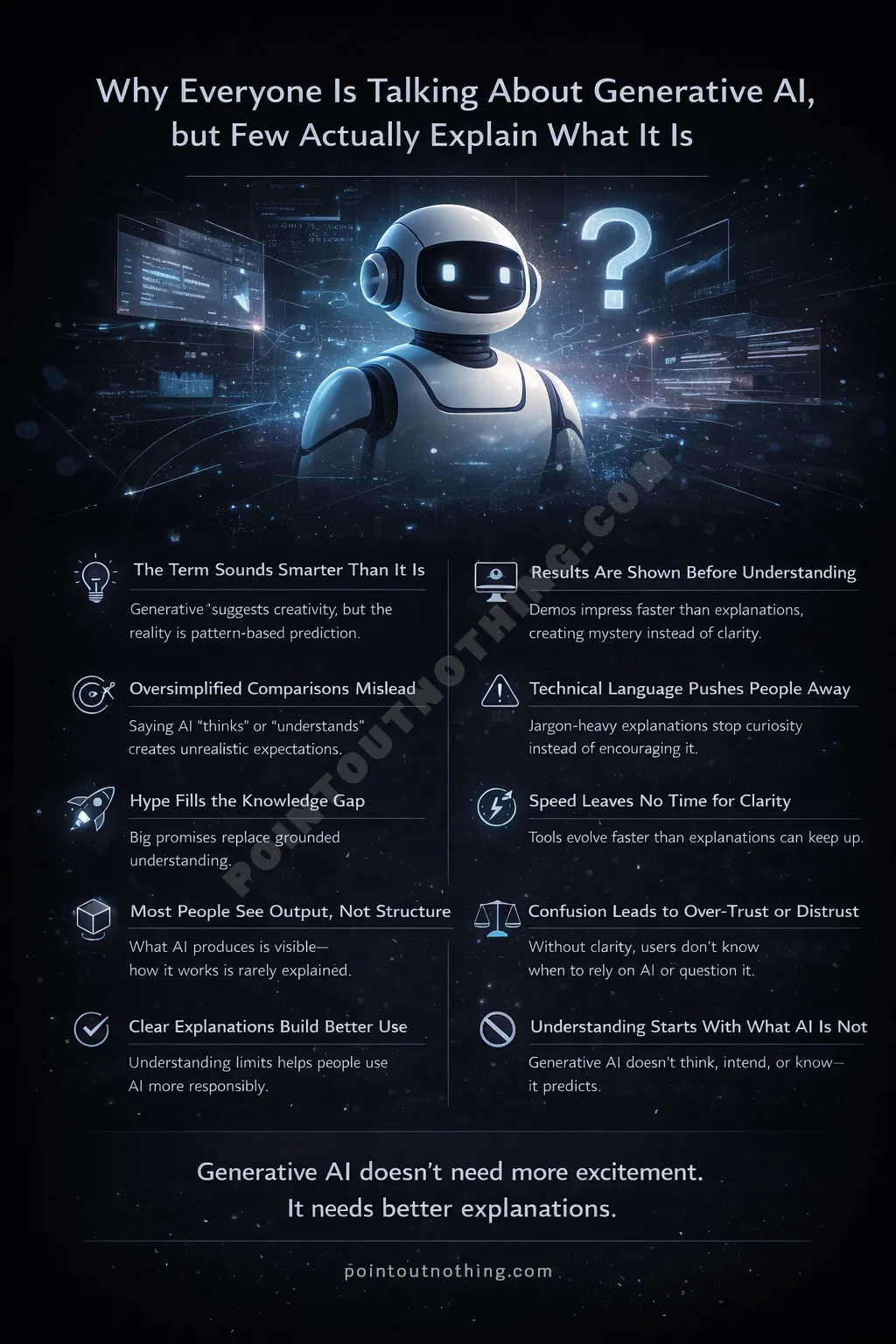
This gap between popularity and clarity is not accidental. Generative AI is widely discussed, but rarely explained in a way that feels grounded and approachable. The result is a topic that sounds important but remains difficult for many people to truly understand.
The Appeal of the Word “Generative”
The word “generative” itself plays a big role in the confusion. It sounds advanced and creative, suggesting something that produces value on its own. When paired with “AI,” it creates an image of intelligence that can invent, imagine, and build without human involvement.
In reality, generative AI does not create in the same way humans do. It generates outputs based on patterns learned from existing data. This distinction is often skipped in everyday explanations because it feels technical, even though it is essential for understanding how these systems actually work.
By focusing on what the technology produces instead of how it produces it, conversations stay surface-level. People see the output and assume intelligence, without being shown the structure behind it.
Demonstrations Replace Explanations
One reason generative AI is rarely explained clearly is that demonstrations are more impressive than explanations. A short video showing an image appear instantly or a paragraph written in seconds captures attention far more effectively than a careful breakdown of the process.
As a result, most discussions start with results. You see what the tool can do before you understand what it needs. This order makes generative AI feel magical, but it also makes it harder to grasp. When the explanation comes later, if it comes at all, it often feels disconnected from the experience.
This demonstration-first approach benefits marketing but not understanding. It encourages excitement without context, leaving many people unsure about how to interpret what they’re seeing.
Oversimplification Creates New Confusion
When explanations do appear, they are often oversimplified. Phrases like “the AI learns like a human” or “it understands language” are used to make the concept feel accessible. While well-intentioned, these comparisons blur important differences.
Generative AI does not understand meaning in the human sense. It predicts likely outcomes based on patterns. When this distinction is ignored, expectations become unrealistic. People assume the system knows intent, emotions, or truth when it is actually responding statistically.
This oversimplification makes the technology feel both powerful and unreliable simultaneously. When it performs well, it seems intelligent. When it fails, it feels broken. Without a clear explanation, users struggle to reconcile these two experiences.
Technical Language Pushes People Away
On the other side, some explanations go too far in the opposite direction. They rely heavily on technical terms such as models, parameters, tokens, and training data. While accurate, this language can feel inaccessible to non-technical audiences.
When explanations require prior knowledge, many people stop asking questions. They accept that generative AI is important, but decide it’s not something they need to fully understand. This creates a passive relationship with the technology, where users rely on it without confidence.
Clear explanations don’t require removing complexity entirely, but they do require translating it. Without that effort, understanding remains limited to a small group.
Hype Fills the Knowledge Gap
Where clarity is missing, hype often takes over. Generative AI is described as revolutionary, transformative, or disruptive, without a clear explanation of what is actually changing. These words generate interest, but they don’t provide understanding.
Hype-driven conversations focus on potential rather than present reality. They encourage people to think about what generative AI might become instead of what it currently is. This keeps discussions abstract and speculative.
For many readers and users, this makes the topic feel distant. It sounds important, but not relatable. The technology feels like something happening elsewhere, driven by companies and experts, rather than a tool with understandable mechanics.
The Role of Speed in Shaping Perception
The rapid pace of generative AI development also contributes to unclear explanations. New tools and features appear so quickly that explanations struggle to keep up. By the time someone understands one system, another version has already replaced it.
This constant motion discourages deep explanation. Why spend time explaining something that may change soon? Instead, conversations stay shallow and reactive, focused on what’s new rather than what’s foundational.
As a result, many people are familiar with the term “generative AI” without ever forming a stable understanding of it.
What Clear Explanation Would Actually Look Like
A clearer explanation of generative AI would start by setting realistic boundaries. It would explain that these systems generate outputs based on patterns, not intention or awareness. It would show how user input shapes results and why outputs can vary.
It would also connect the technology to familiar ideas, without relying on misleading comparisons. Instead of saying it “thinks,” it would explain how it predicts. Instead of saying it “creates,” it would explain how it recombines.
Most importantly, it would acknowledge limitations openly. Clear explanations build trust not by exaggerating capability, but by explaining constraints.
Why Clarity Matters More Than Ever
As generative AI becomes more integrated into daily tools, clarity becomes more important than excitement. People use these systems for writing, designing, planning, and decision-making. Without understanding how they work, users risk over-reliance or misplaced confidence.
Clear explanations empower better use. They help people know when to trust output and when to question it. They turn generative AI from a mysterious force into a practical tool.
Sitting With the Gap
The reason everyone is talking about generative AI while few explain it clearly is not because the technology is impossible to explain. It’s because clarity takes time, patience, and restraint. It requires slowing down in a space that rewards speed.
Until explanations catch up with popularity, this gap will remain. And in that gap, curiosity, confusion, excitement, and misunderstanding will continue to coexist. Understanding generative AI does not start with seeing what it can do. It starts with understanding what it is not. That difference is small, but it changes everything.
Conclusion:
Generative AI isn’t confusing because it’s impossible to understand. It’s confusing because most conversations around it rush past explanation in favor of speed, excitement, and spectacle.
When tools are introduced through demos instead of understanding, people learn what they can do but not why they behave the way they do. That gap creates mixed emotions, excitement when outputs look impressive, frustration when results feel wrong, and uncertainty about when the technology should be trusted.
Clarity changes that relationship.
When people understand that generative AI predicts rather than understands, recombines rather than imagines, and depends heavily on human input, something important happens. The technology becomes less intimidating and more usable. It stops feeling like a mysterious force and starts feeling like a tool with strengths and limits.
As generative AI quietly becomes part of writing, design, planning, and everyday decision-making, understanding matters more than hype. Clear explanations help people use these systems thoughtfully instead of blindly. They encourage curiosity without fear and confidence without over-reliance.
The real problem isn’t that generative AI is talked about too much. It’s explained too little.
And until clarity catches up with popularity, confusion will continue to live right alongside excitement. The moment explanations slow down enough to meet people where they are, that’s when generative AI will start to feel less overwhelming and more human.