This is a clear and thoughtful look at why many AI tools feel impressive at first but still confuse people who are just getting started. It explains the gap between AI promises and real beginner experience in simple language.
At first glance, most AI tools look impressive. They promise speed, automation, and results that once took hours or days. The interfaces are clean, the demos are exciting, and the marketing language makes everything sound simple. Yet for many beginners, the first real experience with an AI tool feels confusing rather than empowering.
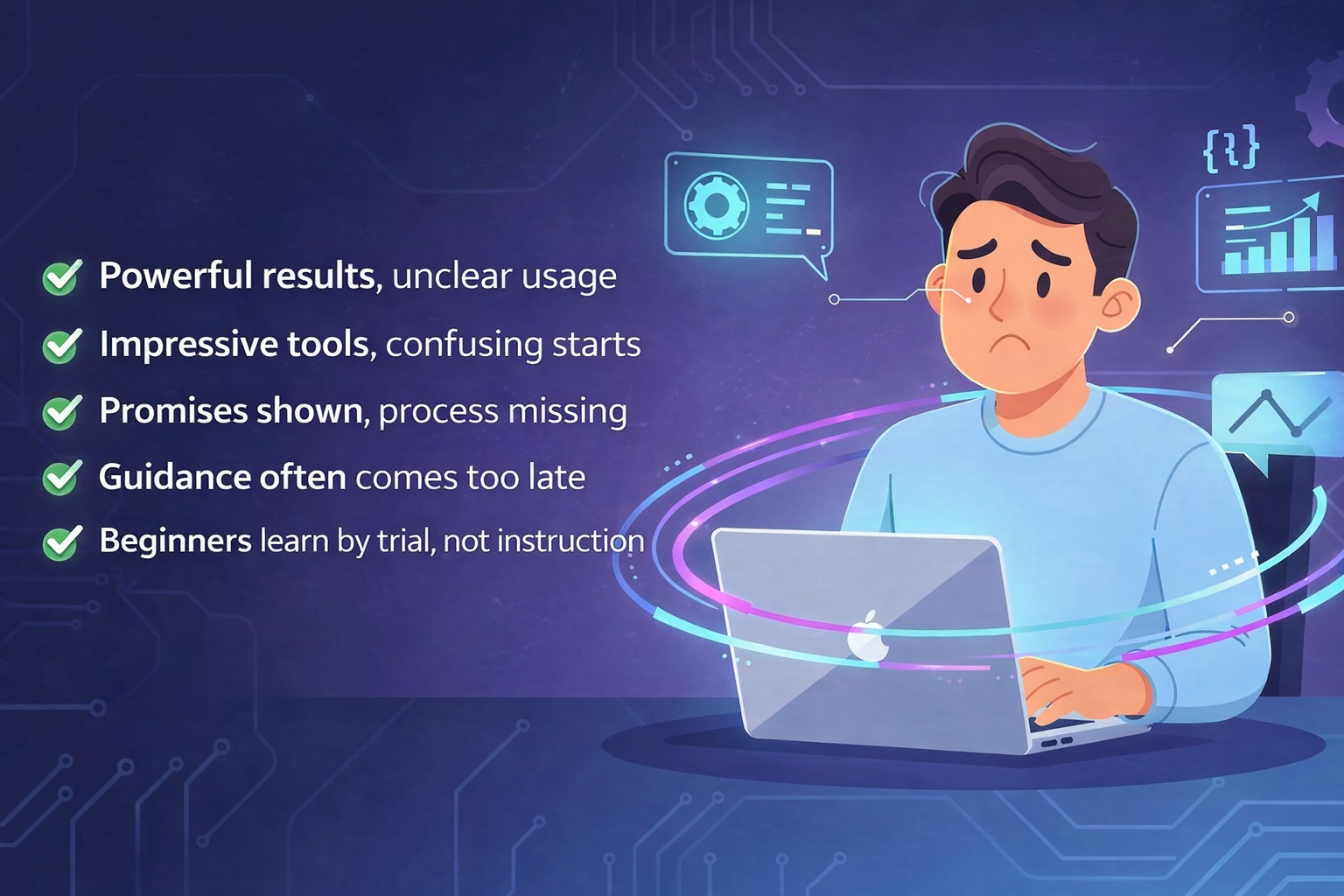
This confusion doesn’t come from a lack of intelligence or effort. It comes from the way these tools are presented and the expectations they quietly set. AI tools often appear powerful on the surface, but the path to using that power is rarely clear for someone just starting out. One reason beginners feel lost is that AI tools skip the middle explanation. They show the end result but not the thinking process. You see what the tool can do, but you don’t see how it gets there or what it needs from you to work well. This creates a strange gap where the tool feels capable, yet unpredictable.
Many AI products assume a level of familiarity that beginners simply don’t have. Terms like prompts, parameters, models, tokens, or training data are often mentioned casually, without much context. For someone new, these words stack up quickly. Instead of learning gradually, the user is thrown into a system that feels like it expects prior knowledge.
Another layer of confusion comes from inconsistent results. A beginner might try the same task twice and get two very different outcomes. This makes the tool feel unreliable, even if it’s actually working as designed. Without understanding why results change, users start guessing instead of learning. Guessing leads to frustration.
There is also the issue of choice overload. Many AI tools offer dozens of options, settings, and modes. While this flexibility is great for advanced users, it can be overwhelming for new users. When everything looks important, nothing feels clear. Beginners often don’t know what to touch and what to leave alone.
The way AI tools are marketed adds to the problem. Demos usually show best-case scenarios. They don’t show mistakes, retries, or adjustments. When a beginner tries to replicate what they saw and fails, it feels like a personal shortcoming. In reality, the demo skipped several invisible steps. AI tools also blur the line between automation and control. Beginners often expect the tool to “just work,” while the tool expects guidance. This mismatch creates disappointment. The user waits for magic, while the system waits for better input. Neither side explains this clearly.
Another quiet issue is fear. Beginners worry about doing something wrong or wasting time. When a tool feels complex, people tend to hesitate when experimenting. They click less, try fewer variations, and stick to safe actions. This limits learning and makes the tool feel even more rigid.
Documentation rarely helps in the early stage. Guides are often written either for complete novices or advanced users, with little in between. Beginners who are past the basics but not yet confident feel stuck in the middle. They know enough to be curious but not enough to be comfortable.
The confusion is not always about technology. It’s about expectations. AI tools are often framed as replacements for effort, when they are actually amplifiers of direction. Without understanding this, beginners feel misled. The tool isn’t failing; the framing is. Over time, some users push through this phase. They experiment, make mistakes, and slowly build intuition. For them, the confusion fades, and the power becomes usable. Others stop early, deciding the tool “isn’t for them,” even though the barrier was never their ability.
What’s interesting is that this pattern repeats across almost every AI category. Writing tools, image generators, music tools, and productivity assistants all show the same curve. Excitement first, confusion next, clarity much later. The tools change, but the experience stays similar.
This suggests the problem isn’t beginners. It’s the design and communication around AI tools. Power without guidance creates friction. Capability without clarity creates doubt. When tools grow faster than understanding, confusion becomes part of the onboarding experience.
AI tools will continue to improve. They will become faster, smarter, and more capable. But unless they also become better at meeting beginners where they are, that first confusing moment will remain. And for many users, that moment decides whether they continue or quietly move on. For now, it’s worth remembering that feeling confused by AI tools is not a failure. It’s a common starting point. The tools may be powerful, but learning how to use power always takes time.
Conclusion
The confusion beginners feel when using AI tools is not a personal failure, nor is it a sign that the technology is broken. It is a natural result of how these tools are introduced, discussed, and positioned. AI products often showcase outcomes before understanding, speed before clarity, and capability before guidance. For someone encountering them for the first time, this creates an experience that feels impressive on the surface but unstable underneath.
What makes this confusion harder to navigate is that it is rarely acknowledged. Beginners are expected to adapt quickly, to “figure it out,” while the tools themselves continue to evolve. This places the burden of clarity on the user rather than on the system. As a result, many people stop experimenting not because they lack interest, but because the experience feels unpredictable and mentally tiring.
Over time, those who continue using AI tools usually discover that the power they admired at first becomes usable only after expectations shift. The tools stop feeling magical and start feeling mechanical. Understanding grows not through explanations alone, but through repetition, mistakes, and gradual familiarity. What once felt confusing becomes manageable, not because the tool changed, but because the relationship with it did.
The early confusion surrounding AI tools is an important stage, even if it is uncomfortable. It reveals the gap between promise and practice, between demonstration and real use. Recognizing this gap can make the experience less frustrating and more honest. AI tools are powerful, but power without clarity always feels uncertain at first.
In that sense, confusion is not the opposite of progress. It is often the starting point of it.