

What If Social Media Disappeared for Brands Overnight? Rethinking Marketing Without Platforms
What if social media disappeared for brands overnight? A thought experiment on visibility, control, communication, and marketing beyond platforms.
Why do ad metrics feel overwhelming at first? A practical look at running ads before the numbers make sense, and how understanding slowly develops.

Running ads for the first time often feels like stepping into a system that speaks a different language. The setup looks manageable, the buttons are clearly labeled, and the promise is simple: put money in, get results out. But once the ads start running and numbers begin to appear, the experience becomes less clear and more uncertain.
Metrics arrive quickly, but understanding them takes time.
At the beginning, seeing numbers feels reassuring. Impressions increase, clicks appear, and graphs start to move. The dashboard looks active, which creates the sense that something is working. Even without a deep understanding, movement itself feels like progress.
This early comfort comes from visibility rather than clarity. Numbers confirm that the system is responding, but they don’t explain what that response means. At this stage, many advertisers feel encouraged simply because the ads are “doing something.”
As campaigns continue, metrics multiply. Reach, impressions, clicks, cost per click, engagement, conversions, and return on spend all appear at once. Each metric seems important, yet its relationships are not immediately obvious.
This creates confusion. High impressions with low clicks feel disappointing. Good clicks with poor conversions feel frustrating. Without context, it becomes difficult to know whether the campaign is succeeding or failing.
Instead of offering clarity, metrics begin to compete for attention.
One of the most challenging parts of running ads without understanding metrics is the lack of a reference point. Numbers appear, but there is no clear baseline. Is a certain click-through rate good or bad? Is a high cost normal or inefficient?
Without experience or comparison, interpretation becomes guesswork. Decisions are made based on feeling rather than insight. Small changes are applied without knowing whether they address the real issue.
This uncertainty makes every adjustment feel risky.
When understanding is limited, it’s tempting to focus on single metrics. If clicks are low, increase the budget. If reach drops, change targeting. If engagement falls, adjust the creative.
While these reactions feel logical, they often ignore the system as a whole. Metrics don’t exist in isolation. Changing one part of the campaign affects others in ways that are not immediately visible.
Chasing individual numbers can create constant motion without meaningful improvement.
Ad platforms are designed to look informative and powerful. Dashboards offer charts, comparisons, and performance summaries. This presentation creates the impression that control is close at hand.
However, visibility does not equal understanding. Seeing data is not the same as knowing what to do with it. Without a clear mental model, dashboards become overwhelming rather than helpful.
Control feels present, but confidence remains absent.
To make sense of metrics, many advertisers turn to guides, videos, and online advice. While helpful in theory, this advice often introduces conflicting priorities. One source emphasizes cost per click, another focuses on conversions, while another warns against optimizing too early.
This flood of guidance can increase confusion. Instead of simplifying decisions, it adds pressure to optimize everything at once. Metrics begin to feel like tests that must be passed rather than tools meant to inform.
As advice accumulates, clarity often decreases.
Understanding ad metrics does not arrive all at once. It develops unevenly, through repetition and observation. Patterns become visible only after time. Certain metrics begin to matter more in specific contexts.
This learning process is rarely acknowledged. Platforms assume users will adapt quickly. When progress feels slow, frustration grows. Many advertisers blame themselves rather than recognizing that interpretation takes experience.
The system moves faster than understanding can.
Running ads without understanding metrics carries emotional weight. Money is involved, which raises the stakes. When results are unclear, doubt sets in. Was the budget wasted? Was the targeting wrong? Was the message ineffective?
This emotional pressure can lead to premature decisions. Campaigns are stopped too early, changes are made too often, and learning is interrupted. The desire for certainty overrides patience.
Over time, a shift occurs. Certain numbers start to feel familiar. Relationships between metrics become clearer. Instead of reacting to daily fluctuations, advertisers begin to look for trends.
This moment doesn’t eliminate complexity, but it reduces anxiety. Metrics become signals rather than judgments. Decisions feel more grounded, even when results are mixed.
Understanding does not simplify the system, but it stabilizes the experience.
Eventually, metrics stop feeling like obstacles and start feeling like context. Not every number demands action. Not every dip signals failure. The focus moves from perfection to direction.
Running ads becomes less about controlling every outcome and more about learning from patterns. This shift changes the emotional tone of the work. Confidence grows, not from mastery, but from familiarity.
Running ads without understanding the metrics is not a mistake; it is a stage. Most advertisers pass through it quietly. The confusion is not a sign of incompetence, but of entry into a complex system.
Metrics are meant to inform, not intimidate. Understanding them takes time, repetition, and restraint. Once that is accepted, the experience becomes less stressful and more sustainable.
The numbers don’t change overnight. But the way they are read does. And that change makes all the difference.
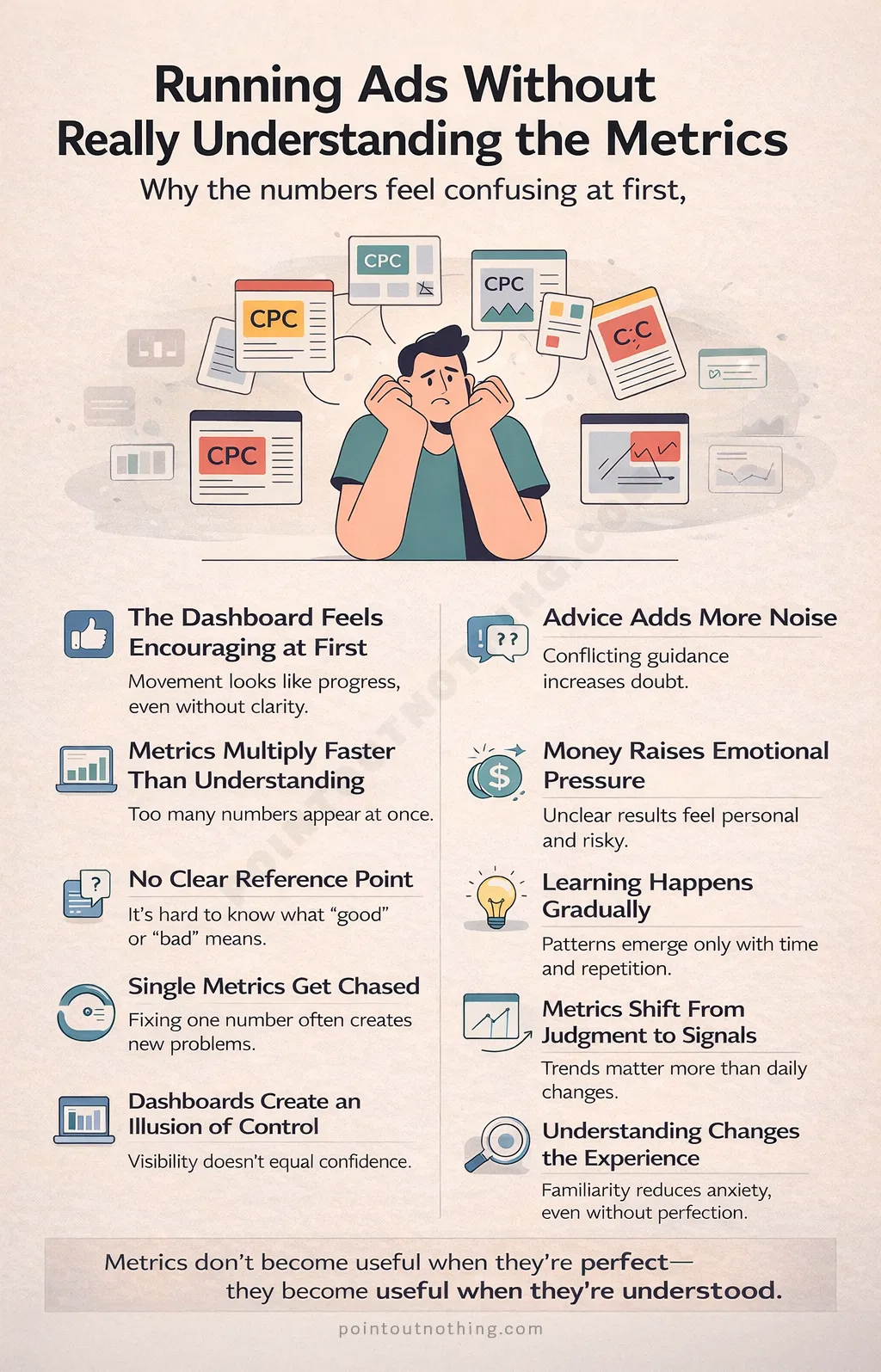
Running ads without really understanding the metrics is not a mistake; it’s how most people start. The dashboards don’t wait for clarity. The numbers appear immediately, while understanding arrives slowly, in fragments, over time.
Early on, metrics feel like judgments. Every number seems to say something about success or failure, even when it doesn’t. This is where anxiety creeps in. Money is being spent, results feel unclear, and confidence starts to wobble. The pressure to “fix” things quickly can interrupt the very learning the metrics are meant to support.
What changes the experience isn’t mastery, it’s familiarity.
When advertisers stop reacting to individual numbers and start observing patterns, metrics shift from being intimidating to being informative. Not every dip feels alarming. Not every spike feels like success. The data becomes context rather than verdict. Understanding metrics doesn’t mean controlling outcomes. It means knowing what questions to ask and which numbers deserve attention in a given moment. That understanding grows unevenly and quietly, through repetition, patience, and restraint.
The important shift is recognizing that confusion is incompetence; it’s part of the process. Once that’s accepted, running ads becomes less emotionally heavy and more sustainable. The numbers don’t suddenly simplify, but the relationship with them does.
And that change, how the data is read, not what it shows, is what ultimately makes running ads feel manageable.
What if social media disappeared for brands overnight? A thought experiment on visibility, control, communication, and marketing beyond platforms.

Social media marketing often feels more complicated than it should be. This article explores why platforms, metrics, tools, and pressure create unnecessary complexity.