
What If Social Media Disappeared for Brands Overnight? Rethinking Marketing Without Platforms
What if social media disappeared for brands overnight? A thought experiment on visibility, control, communication, and marketing beyond platforms.
Social media marketing often feels more complicated than it should be. This article explores why platforms, metrics, tools, and pressure create unnecessary complexity.

Social media marketing is often described as simple. Post consistently, engage with the audience, analyze performance, and adjust strategy. On paper, the process looks straightforward. In practice, however, it rarely feels that way. For many people, social media marketing feels confusing, fragmented, and heavier than expected, even when the basic goals remain clear.
This complexity is not always caused by the work itself. Much of it comes from the environment in which the work exists.
One of the first sources of complexity is the number of platforms involved. Each platform presents itself as essential, each with its own formats, algorithms, metrics, and best practices. What works on one platform rarely translates cleanly to another.
This forces marketers to split attention. Instead of focusing on message quality or audience understanding, energy is spent adapting the same idea into multiple shapes. Over time, this fragmentation makes the entire process feel scattered rather than strategic.
Social media platforms change frequently. Features are introduced, removed, or reworked with little explanation. Algorithms shift quietly, and performance fluctuates without an obvious cause.
For marketers, this creates uncertainty. A strategy that worked last month may stop working today. Without clear feedback loops, it becomes difficult to understand whether results changed due to content quality, timing, platform behavior, or external factors.
This uncertainty turns planning into guesswork. Instead of refining ideas, marketers spend time reacting.
Social media offers an abundance of metrics. Likes, shares, reach, impressions, engagement rates, click-throughs, and conversions all compete for attention. While data is meant to clarify performance, it often complicates it.
Different metrics suggest different interpretations. High reach with low engagement feels confusing. Strong engagement without conversions feels incomplete. Deciding which numbers matter most depends on the context, which is rarely obvious.
As a result, data becomes something to interpret constantly rather than a guide that simplifies decisions.
To manage complexity, marketers turn to tools. Scheduling platforms, analytics dashboards, automation software, and content planners all promise efficiency. While these tools can be helpful, they also introduce new systems to learn and maintain.
Each tool comes with its own interface, terminology, and limitations. Instead of reducing complexity, they often reorganize it. The work doesn’t disappear; it shifts location.
Over time, managing tools becomes part of the workload rather than a solution to it.
Social media marketing carries an unspoken expectation of presence. Brands are encouraged to post regularly, respond quickly, follow trends, and maintain a consistent voice. Falling behind feels risky.
This pressure creates tension between quality and quantity. Posting less feels like neglect. Posting more risks dilution. Finding balance becomes a constant internal negotiation.
The result is often exhaustion rather than clarity.
One reason social media marketing feels complicated is the volume of advice surrounding it. Experts recommend different strategies, sometimes contradicting each other. What one guide treats as essential, another dismisses as outdated.
This creates confusion, especially for those trying to follow best practices. Without a clear reference point, decision-making becomes reactive. Strategies are changed frequently, not because results demand it, but because advice shifts.
Instead of building confidence, this environment encourages doubt.
At its core, social media marketing is about communication. Sharing messages with the right audience, at the right time, in a way that feels relevant. This idea has not changed.
What has changed is the number of layers between intention and execution. Platforms, metrics, tools, trends, and expectations all sit between the marketer and the audience. Each layer adds friction.
As layers accumulate, simplicity becomes harder to access, even though the underlying goal remains the same.
For many marketers, clarity returns when they step back. Focusing on fewer platforms, fewer metrics, and fewer tools often reduces confusion. Understanding the audience matters more than understanding every feature.
The complexity of social media marketing is real, but it is not always necessary. Much of it is optional, reinforced by pressure rather than requirement.
Social media will continue to evolve, and complexity will likely increase. New features and formats will appear, and advice will continue to circulate. The challenge is not eliminating complexity, but recognizing which parts are essential.
When the noise is filtered out, what remains is simpler than it appears. Communication, consistency, and relevance still matter most. Everything else is context.
Understanding this doesn’t remove difficulty, but it reframes it. Social media marketing feels complicated because it has been layered with expectations. Beneath those layers, the work itself is more straightforward than it often seems.
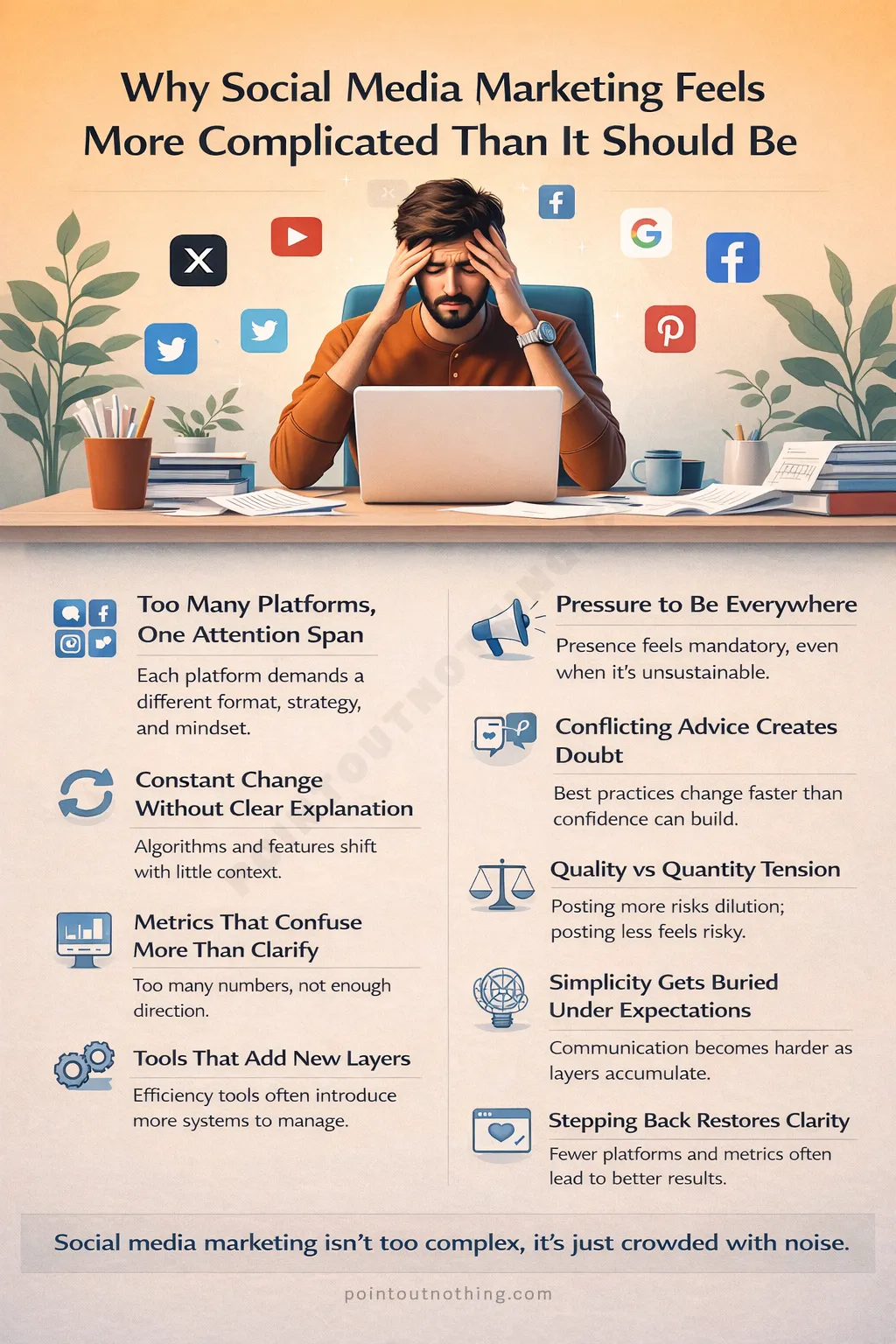
Social media marketing feels complicated, not because the core idea is difficult, but because too many layers sit between the message and the audience.
At its heart, the work hasn’t changed much. It’s still about understanding people, sharing something relevant, and building trust over time. What has changed is the environment around that work. Platforms multiply, Features evolve, Metrics expand, Advice contradicts itself, and Expectations quietly grow.
Each layer adds friction. Not always because it’s necessary, but because it exists.
When marketers feel overwhelmed, it’s often not because they lack skill or discipline. It’s because they’re trying to respond to everything at once, every platform, every metric, every trend, every piece of advice. The effort goes into managing the system instead of communicating within it.
Clarity usually returns when something is removed, not added. Fewer platforms create focus. Fewer metrics create direction. Fewer tools reduce mental load. And fewer external opinions allow confidence to grow. Social media marketing doesn’t become simple by ignoring reality. It becomes manageable by recognizing the difference between what’s essential and what’s noise. When that distinction is made, the work feels lighter, not because expectations disappear, but because attention is finally placed where it matters most.
The complexity is real. But much of it is optional. And noticing that difference is often the first step toward doing better work with less exhaustion.
What if social media disappeared for brands overnight? A thought experiment on visibility, control, communication, and marketing beyond platforms.

Why do ad metrics feel overwhelming at first? A practical look at running ads before the numbers make sense, and how understanding slowly develops.