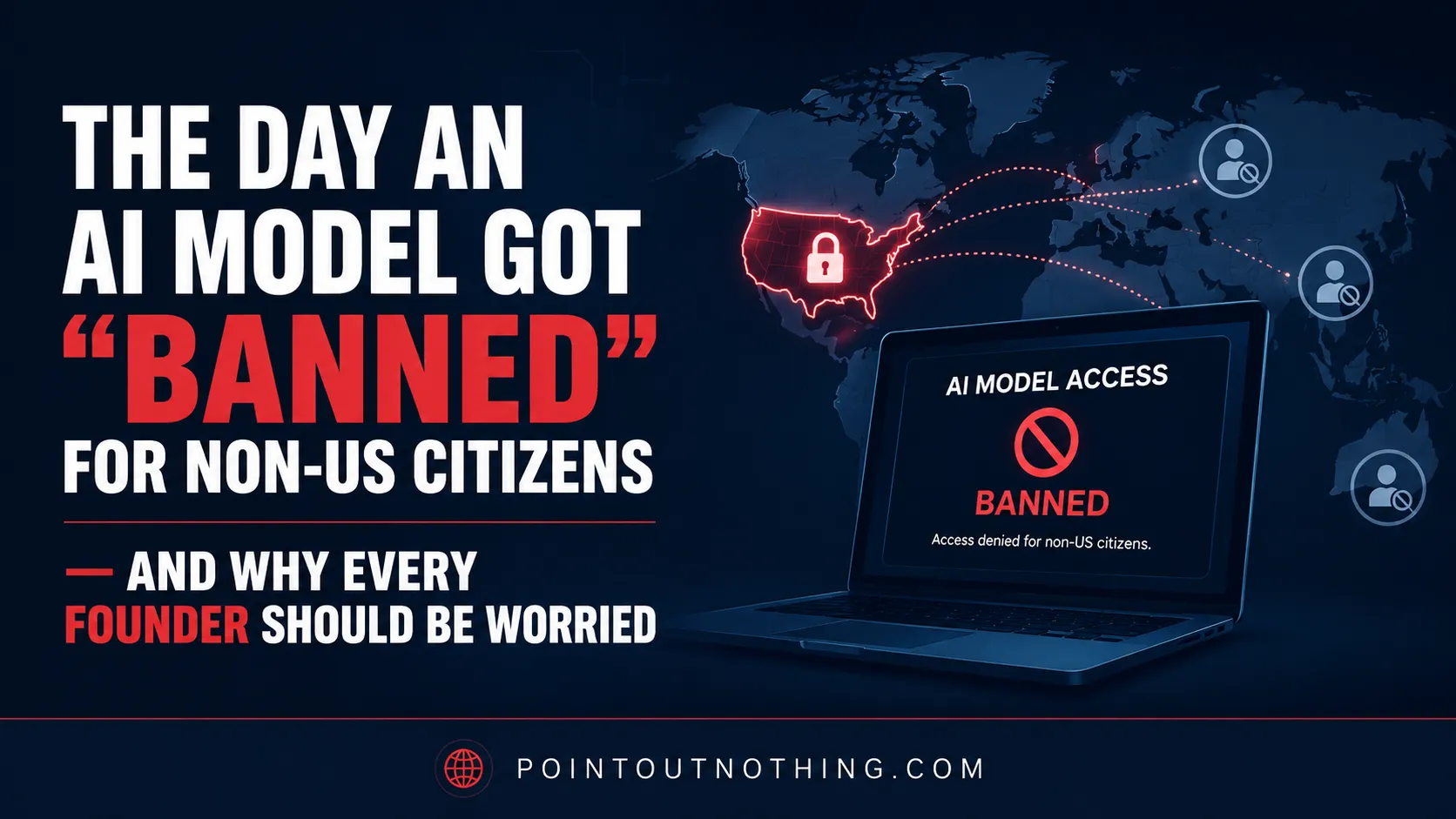
If a top AI model can be switched off overnight for most of the planet, what happens to the business you built on top of it? Here's the full story of the Fable 5 and Mythos 5 ban.
The uncomfortable questions it leaves behind.
It started with a single letter on a Friday evening
Picture this. It's Friday, June 12, 2026. Somewhere in San Francisco, the team at Anthropic, the company behind Claude is winding down for the weekend. Then, at 5:21 PM Eastern Time, a letter lands.
It's not a customer complaint. It's not a partnership deal. It's a directive from the US government, citing national security, ordering the company to cut off access to its two most powerful AI models — Fable 5 and Mythos 5 — for every foreign national on Earth.
Not just people sitting in India, or Europe, or anywhere outside America. The order covered foreign nationals inside the United States too. It even covered Anthropic's own employees who aren't US citizens.
Read that again. A company was told it could not let its own non‑American staff use the product they helped build.
By late Friday night, Anthropic did the only thing it could do to comply: it pulled the plug on Fable 5 and Mythos 5 for everyone (Americans included). Because there was simply no clean way to keep it on for citizens only without risking a violation.
This had never happened before. And if you build anything on AI, a startup, a side project, a content workflow, a SaaS tool - this is the story you need to understand.
Wait... What even are Fable and Mythos?
Let's slow down, because most people outside the AI bubble have never heard these names.
Anthropic's well‑known models are the Claude family — Opus, Sonnet, Haiku. The one I'm using to write and research right now, Claude Opus 4.8, sits in that family. Powerful, popular, used by millions.
But above Opus, Anthropic built something more capable: a tier they call Mythos‑class.
- Mythos 5 is the full, raw, ultra‑capable version. It was never opened up to the general public. It's been used by a small set of trusted partners and government agencies — mainly to find security holes in software. And here's the wild part: it's reportedly so good at spotting software vulnerabilities that it has found flaws which sat hidden for decades.
- Fable 5 is the public‑facing sibling. Same underlying brain as Mythos, but with heavy safety guardrails bolted on so the dangerous capabilities (think cybersecurity and biotech) stay locked away. Fable 5 launched just this week. It was supposed to be the safe, commercial version regular people and businesses could actually use.
So the model that got the public excited was barely days old when the government's letter killed it.
So why was it banned? The "jailbreak" everyone's arguing about
Here's where it gets messy, and honestly, a little absurd.
The government's stated reason was national security. According to Anthropic, officials believed someone had found a way to "jailbreak" Fable 5. A trick to get past its safety guardrails and unlock Mythos's powerful cybersecurity abilities underneath.
But Anthropic pushed back hard. In its public statement, the company said the so‑called jailbreak was narrow. It basically amounted to asking the model to read a specific piece of code and fix the bugs in it. The vulnerabilities it surfaced were minor and already known. And critically, Anthropic said the exact same thing can be done with other public models, including OpenAI's GPT‑5.5 - which is not under any such ban.
In their words, they disagreed that one narrow potential jailbreak should justify recalling a model used by hundreds of millions of people. They warned that if this became the standard across the industry, it would basically freeze every new AI model launch from every company.
Anthropic called the whole thing "a misunderstanding" and said it's working to restore access.
The internet did not stay quiet
When the news broke, the AI world reacted with a mix of disbelief, anger, and from some corners a grim "told you so." Here are the real voices, with links so you can grab the screenshots yourself.
Dean Ball (AI policy expert, former Trump‑administration advisor turned critic) didn't hold back. He said he couldn't tell whether this was targeted "lawfare" against Anthropic or just extreme national‑security paranoia, and called the whole thing "cartoonish." He pointed out the irony: an administration that wants to export advanced AI chips to China was now trying to ban Britain, and every other non‑American on the planet from using the best US models. His reaction, in short: "I have no words."
Peter Girnus (cybersecurity researcher) took the harsher "you reaped what you sowed" angle. His point: Anthropic spent years describing its models almost like weapons to make a safety argument, so eventually the government took them at their word. As he put it, "If you describe your product as a munition in every press release," don't be shocked when regulators treat it like one.
Gary Marcus (longtime AI‑industry skeptic) argued the move made little sense, especially for a government obsessed with "beating China." He warned it could push Chinese‑born researchers working at US labs to simply go home, and make global investors nervous about betting on American AI at all.
Where the developer crowd is talking: the real day‑to‑day panic "my app just broke," "what do I migrate to," "is Opus next" is bubbling up on Reddit (r/ClaudeAI, r/singularity, r/LocalLLaMA) and in Hacker News threads. I'd recommend searching those directly for fresh screenshots, because that's where the builder emotion lives, separate from the policy commentary on X.
This wasn't out of nowhere, the backstory matters
Here's the part that turns this from "weird one‑off" into "pattern." This ban didn't fall from the sky. Tension between Anthropic and the US government had been building for months.
- Back in February 2026, the Trump administration reportedly ordered federal agencies to stop using Anthropic's models — after the company refused the Pentagon's preferred contract terms. Anthropic wanted exemptions so its AI couldn't be used for autonomous weapons or mass domestic surveillance.
- In March, the Pentagon labeled Anthropic a "supply chain risk," barring the military and defense contractors from using its models. Anthropic is fighting that in federal court.
- Several prominent tech‑policy figures in the administration had been publicly attacking the company for months.
And the timing? Anthropic had just confidentially filed to go public, reportedly at a valuation near $965 billion. A surprise government ban is the last thing you want hanging over an IPO.
So depending on who you ask, this ban is either (a) a genuine security precaution, or (b) the latest move in an ongoing political fight. Reasonable people are reading it both ways and that ambiguity is exactly why founders should pay attention.
Now the real question: What does this mean for the rest of us?
Okay. Deep breath. Let's get to the part that actually keeps builders up at night.
You and I both know how this goes. You discover a great model. You build your whole workflow, your product, your content engine, your customer support, your business on top of it. It feels like infrastructure. Permanent. Like electricity.
And then one Friday evening, a letter arrives, and the lights go out.
Right now, the ban only hits Fable 5 and Mythos 5. Everything else, including Claude Opus 4.8, the workhorse a lot of people (me included) actually build on, is untouched and working fine. So if you're on Opus, Sonnet, Haiku, GPT, or Gemini today, nothing has changed for you yet.
But "yet" is the scariest three‑letter word in tech.
Let's play out the hypotheticals (because you should)
I'm not saying these will happen. I'm saying a sensible founder games them out before they happen.
Scenario 1: What if Opus 4.8 is next? Say you've built a thriving business on Opus 4.8. Customers love it. Revenue's flowing. Then one morning it's restricted, geographically, or by citizenship, or recalled entirely over some new "concern." Your product doesn't just slow down; for a chunk of your users, it simply stops. Refunds. Angry emails. A scramble to migrate prompts and fine‑tuning to a different model that behaves differently. Days of downtime you didn't budget for. The Fable case proves this isn't paranoia, it's now a documented possibility.
Scenario 2: What if it's Gemini, and your whole stack is Google? Imagine you went all‑in on Gemini. Your app, your automations, your data pipelines, all wired into one provider. Now imagine access gets blocked in your region, or globally, overnight. A business with zero fallback doesn't have a bad week; it has an existential crisis. One provider, one point of failure.
Scenario 3: The open‑source escape hatch. This is the one a lot of builders are quietly thinking about now. Open‑weight models, the kind you can download and run on your own servers, can't be remotely switched off by anyone. No government can email a model that's already sitting on your hard drive. The trade‑off is real: open models are often a step behind the absolute frontier, and running them yourself takes more money and skill. But after a week like this, "a bit less powerful but nobody can take it away" suddenly sounds very attractive.
The bigger lesson: Stop treating AI as permanent infrastructure
Here's the mindset shift this whole episode should trigger.
We've been treating frontier AI models like tap water, always on, always there. But they're not. They're products, owned by companies, operating inside laws and politics that can change with a single letter on a Friday evening.
That doesn't mean stop building with AI. Far from it. It means build like a grown‑up:
- Never marry one model. Design your system so you can swap providers without rewriting everything. Keep your prompts and logic in a layer that's model‑agnostic where you can.
- Have a "what if it disappears tomorrow" plan. For your most important workflow, know your backup model today — not the day it breaks.
- Keep an open‑source option in your back pocket. Even if you don't run it now, know which open model you'd fall back to and roughly how.
- Don't put irreplaceable, business‑critical logic somewhere you can be locked out of. Own your data and your core IP.
- Watch the policy news, not just the product news. The next big disruption to your business might come from a regulator, not a competitor.
A quick reality check (because hype cuts both ways)
I want to be fair here. A few grounding truths:
- This is one ban, on two specific models, and Anthropic says it's a misunderstanding it's actively trying to reverse. Access may well come back soon.
- The most widely‑used models, including Opus 4.8 and rival models from other labs, are still fully available.
- Some AI‑safety advocates actually see a silver lining, anything that slows down the race toward extremely powerful AI is, to them, a feature, not a bug.
So this isn't "AI is collapsing." It's a warning shot. A very loud, very public reminder that the ground under our digital businesses is less solid than it feels.
The takeaway
A few days ago, Fable 5 was a shiny new launch. Today it's a cautionary tale.
The lesson isn't "don't build on AI." It's "don't build on the assumption that any single AI will always be there." Treat your model like a vendor, not a law of nature. Keep your options open. Keep a backup. And keep watching, because in this industry, the thing that breaks your business might not be code at all. It might be a letter that arrives at 5:21 on a Friday.
Build smart. Stay flexible. And never let your whole future depend on a switch someone else controls.
Sources & further reading (for links / credibility)
Anthropic's official statement: https://www.anthropic.com/news/fable-mythos-access
Al Jazeera: https://www.aljazeera.com/news/2026/6/13/us-orders-anthropic-to-disable-ai-models-for-all-foreign-nationals
Fortune: https://fortune.com/2026/06/13/anthropic-disables-fable-mythos-export-controls-national-security-threat/
CNN Business: https://www.cnn.com/2026/06/13/business/anthropic-mythos-model-national-security
CNBC: https://www.cnbc.com/2026/06/12/anthropic-disables-access-to-fable-5-and-mythos-5-to-comply-with-government-directive.html
The Decoder: https://the-decoder.com/us-government-forces-anthropic-to-disable-claude-fable-5-and-mythos-5-for-all-customers-worldwide/